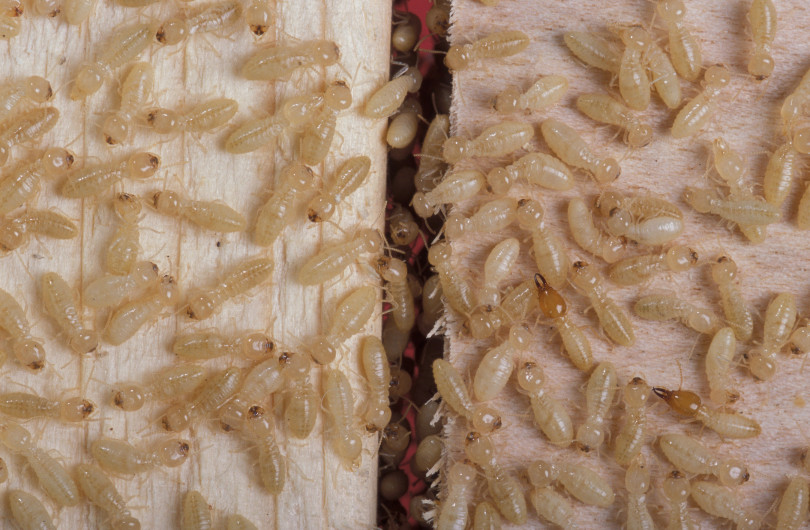
The treatment of termites during the sale of your property has always caused issues with the seller and buyer on what should be done prior to putting your home on the market, who should pay for the treatment and damage, or what is customary in dealing with termites. And of course how termites are handled by homeowners that own single family detached homes or a condominium governed by HOA’s are completely different.
Major termite issues with condominiums or townhomes usually come up during the sale of a unit in which the HOA normally covers the cost of extermination and repair of exterior wood damage. (Not all HOAs cover the cost of treating termites.) The extermination of the termites is usually handled by using spot treatment of chemicals because the tenting of an entire building involving several homeowners is not feasible or necessary to solve the termite problem. However, in some cases the termite damage can only be solved by tenting the entire building.
I would like to bring attention to this aspect of the HOA’s authority in mandating that each unit in a condominium building be tented for termites. A recent article written by Kelly G. Richardson, Managing Partner of Richarson Harman Ober PC, identifies the termite-tenting requirement is reinforced by California civil code. I have included excerpts of Richardson’s article below that explains the HOA’s authority under the civil code to enforce homeowners to evacuate to permit tenting.
Termite treatment in associations is often a controversial issue. Some years ago in La Jolla, the La Jolla Shores Clubdominium HOA board had decided, after consulting an expert, to spot treat termite infestations in the property. A homeowner believed the association was negligent in not tenting the buildings and sued the HOA. In the landmark 1999 case of Lambden v. La Jolla Shores Clubdominium HOA, the California Supreme Court adopted a rule of judicial deference toward HOA maintenance decisions, so long as the board observed the Business Judgment Rule. Presumably, your association has likewise obtained input from experts before deciding that tenting is the best approach.
It can at times be difficult to get residents to cooperate. Some residents find the selected date inconvenient, some do not make it a priority, and others simply fear the process of tenting their homes. Civil Code 4785 provides an important tool for HOAs regarding termite treatment. If the HOA provides at least 15 days advance written notice to the occupants and owner, and the occupants do not vacate the premises, the HOA can “cause the summary removal” of the occupant so that the treatment can proceed.
The association normally will notify owners and occupants well in advance of the upcoming treatment, and send each owner not only information from the termite treatment company about preparing their home, but also an acknowledgment form in which the occupants confirm they will vacate the home for the required dates.
The “summary removal” mentioned in the statute does not mean the HOA can physically eject the occupants. Legal process still must be invoked. Usually, this is in the form of an emergency court order from a judge. After obtaining the order, the HOA can proceed to open the unit for the treatment to proceed. The assistance of law enforcement may be needed if the occupants still refuse to leave.
Not all HOAs have the same responsibility regarding termite treatment. Under Civil Code 4780, condominium, cooperative, and community apartment associations are responsible for termite treatment, unless the CC&Rs provide otherwise. However, under Civil 4780(b), planned developments are not responsible for termite treatment, unless the CC&Rs provide otherwise.
For planned developments in which the residences are attached (typically in townhouse configuration), this can be a problem, since most original CC&Rs do not mention termite treatment. Without a CC&R provision empowering the HOA to prevent termites, the planned development association may not be able to properly protect the structures. Attached planned development association boards should consult their legal counsel on this issue.
Homeowners should cooperate with the HOA treatment plan, which protects their investment.